
Why Am I Still Tired After 8 Hours of Sleep? The Real Reason
You did everything right. You went to bed at a reasonable hour, slept a full eight hours, and set your alarm like a responsible adult. Yet somehow, you woke up groggy, foggy-headed, and desperate for a nap before you’d even had breakfast.
If this sounds familiar, you’re not alone — and more importantly, there’s nothing wrong with you. The problem almost certainly isn’t how long you slept. It’s when you woke up in relation to your sleep cycle.
In this article, we’ll break down the real science behind post-sleep grogginess, explain why eight hours isn’t always the magic number, and show you exactly how to time your sleep so you wake up feeling refreshed instead of exhausted.

Sleep Isn’t One Long Block — It’s a Series of Cycles
Most people think of sleep as a single, uniform state: you close your eyes, you’re “asleep,” and you stay that way until the alarm goes off. In reality, your brain moves through repeating cycles throughout the night, each lasting roughly 90 minutes.
Each cycle passes through several stages:
- Light sleep – the transition phase where your body starts to relax and your heart rate slows.
- Deep sleep – the most physically restorative stage, where tissue repair and immune function happen.
- REM sleep (Rapid Eye Movement) – the stage most associated with dreaming and memory consolidation.
After REM, your brain briefly moves back toward lighter sleep before starting the next 90-minute cycle. A full night typically includes five to six of these cycles, each one slightly different in composition — deep sleep dominates the earlier cycles, while REM sleep becomes more prominent later in the night.
The Real Culprit: Sleep Inertia
Here’s the key insight: how you feel when you wake up depends heavily on which stage of the cycle you’re in when the alarm goes off — not simply on the total number of hours you slept.
If your alarm interrupts you during deep sleep, your brain is pulled out of its most restorative, low-arousal state. This causes a well-documented phenomenon called sleep inertia — a period of grogginess, disorientation, and reduced cognitive performance that can last anywhere from a few minutes to over an hour.
Waking up during light sleep, by contrast, feels far more natural. Your brain is already closer to an alert state, so the transition to wakefulness is smoother and faster.
This is why two people can both sleep exactly eight hours and have completely different mornings — one wakes up mid-cycle and feels wrecked, while the other wakes up between cycles and feels great.
Why 8 Hours Can Actually Be the “Wrong” Amount
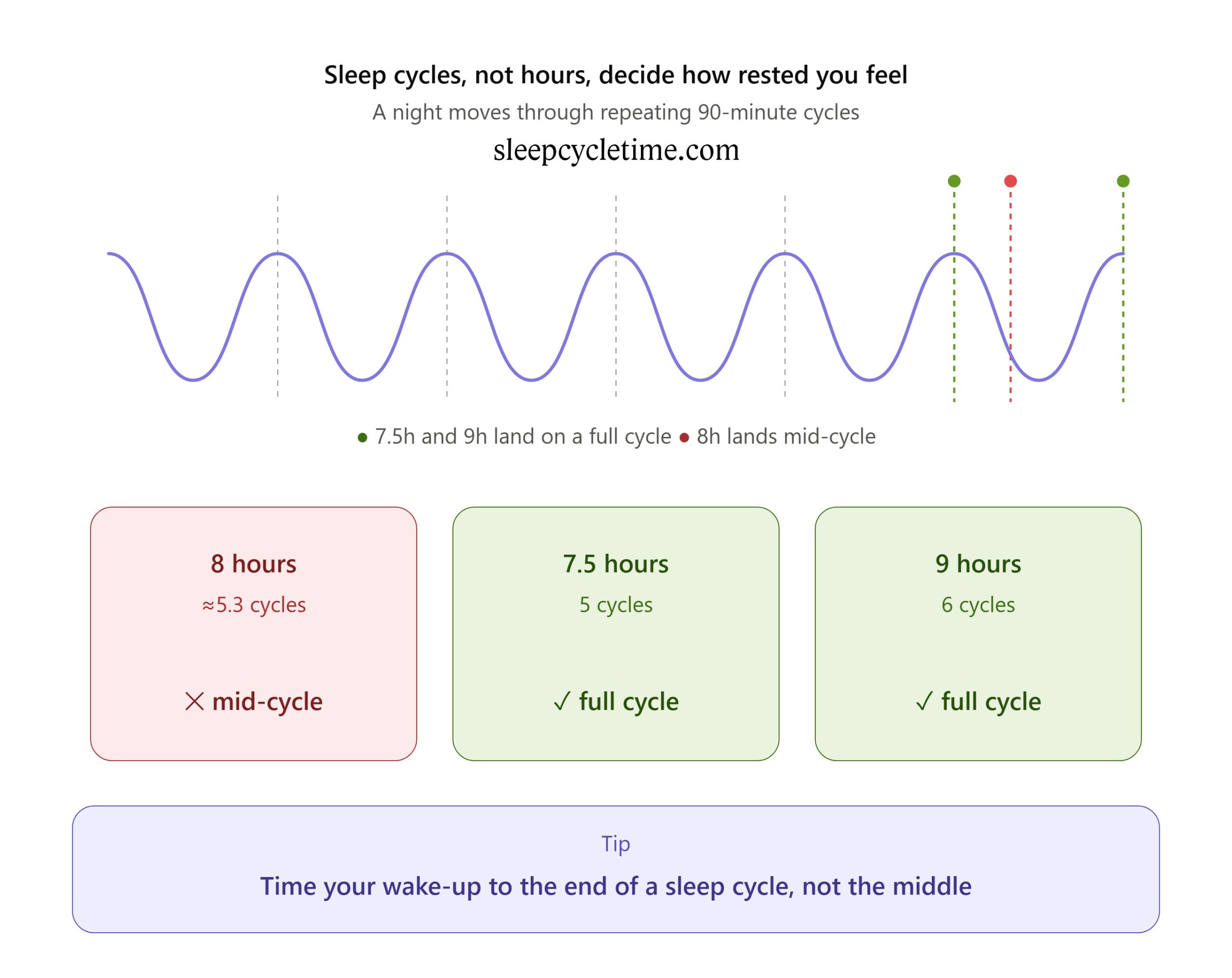
This is the part most people never learn in school, and it’s genuinely surprising the first time you hear it: eight hours doesn’t divide evenly into 90-minute cycles.
Do the math:
- 8 hours = 480 minutes
- 480 ÷ 90 = 5.33 cycles
That extra one-third of a cycle means you’re likely to wake up somewhere in the middle of a cycle — often during deep sleep — rather than at a natural break point between cycles.
Compare that to durations that align cleanly with full cycles:
- 7.5 hours = 5 complete cycles (450 minutes)
- 9 hours = 6 complete cycles (540 minutes)
This is why so many people report feeling more rested after 7.5 hours of sleep than after a full 8 — even though it’s technically less total sleep. It’s not a fluke. It’s simple math combined with sleep architecture.
Other Factors That Can Make You Feel Tired Despite “Enough” Sleep
While cycle timing is the biggest overlooked factor, it’s not the only one. A few other things can contribute to that groggy, unrefreshed feeling even after a seemingly adequate night:
- Inconsistent sleep and wake times. Going to bed at different times each night disrupts your circadian rhythm, making it harder for your body to predict and optimize its sleep cycles.
- Poor sleep quality. Noise, light, an uncomfortable mattress, or a partner’s movements can cause micro-awakenings you don’t consciously remember but that still fragment your sleep.
- Caffeine and alcohol. Caffeine late in the day can delay sleep onset, while alcohol — despite making you feel drowsy — actually suppresses REM sleep and leads to more fragmented rest.
- Underlying sleep disorders. Conditions like sleep apnea, restless leg syndrome, or chronic insomnia can prevent you from reaching deep, restorative sleep stages even if you’re technically “asleep” for eight hours. If grogginess persists despite good sleep habits, it’s worth speaking with a doctor or sleep specialist.
These factors matter, but for most healthy sleepers, the single biggest lever you can pull is timing your wake-up to align with the end of a sleep cycle rather than fixating on a specific number of hours.
How to Fix It: Align Your Wake-Up Time With Your Sleep Cycles
The good news is that this is a solvable problem, and it doesn’t require any special equipment or drastic lifestyle changes. The idea is simple: instead of counting hours, count cycles.
Here’s how it works in practice:
- Pick your target bedtime or wake-up time.
- Add 15 minutes to account for the average time it takes to fall asleep.
- Count forward (or backward) in 90-minute increments to find wake-up times that land at the end of a full cycle rather than in the middle of one.
For example, if you go to bed at 11:00 PM, your ideal wake-up times — accounting for the 15-minute onset window — would fall around:
- 12:45 AM (1 cycle — too short, not practical, just for illustration)
- 2:15 AM (2 cycles)
- 3:45 AM (3 cycles)
- 5:15 AM (4 cycles)
- 6:45 AM (5 cycles — a strong, realistic option)
- 8:15 AM (6 cycles — ideal if your schedule allows it)
Manually calculating this every night is tedious, which is exactly why cycle-based sleep calculators exist. Instead of doing the math yourself, you can simply enter your desired wake-up time (or your bedtime) and instantly see the optimal times that align with completed sleep cycles.
Use our free Sleep Cycle Calculator to find your ideal bedtime or wake-up time in seconds — no math required.
Quick Tips for Waking Up More Refreshed
Beyond cycle timing, a few small habits can meaningfully improve how rested you feel:
- Keep a consistent sleep schedule, even on weekends, to stabilize your circadian rhythm.
- Avoid screens and blue light for 30–60 minutes before bed, since blue light suppresses melatonin production.
- Limit caffeine after early afternoon, as it can stay in your system for six hours or more.
- Use a cycle-based calculator instead of guessing your bedtime or alarm time based on a flat number of hours.
- Get natural light exposure in the morning, which helps reinforce a healthy sleep-wake rhythm.
Frequently Asked Questions
- Is 8 hours of sleep always the healthiest amount? Not necessarily. While 7–9 hours is the generally recommended range for adults, the quality and timing of your sleep matter just as much as the total duration. Waking up at the end of a completed sleep cycle often feels better than waking up mid-cycle, even with fewer total hours.
- What is sleep inertia? Sleep inertia is the temporary grogginess, confusion, and reduced alertness that occurs when you wake up abruptly, especially during deep sleep. It typically fades within 15–60 minutes but can affect your mood and performance during that window.
- Why do I feel more tired after sleeping too long? Oversleeping can push you into a new cycle that gets interrupted, or it can throw off your circadian rhythm, leading to grogginess similar to waking up mid-cycle. More sleep isn’t always better if it disrupts your natural cycle pattern.
- How many sleep cycles should I aim for each night? Most adults benefit from 5–6 complete 90-minute cycles per night, which translates to roughly 7.5–9 hours of sleep. The right number varies slightly by individual, but aligning your wake-up time with the end of a cycle is more important than hitting an exact hour count.
The Bottom Line
Feeling tired after a full 8 hours of sleep isn’t a sign that something is broken — it’s usually a sign that you woke up at the wrong point in your sleep cycle. By shifting your focus from “how many hours” to “how many complete cycles,” you can wake up feeling noticeably more alert, even without changing your total time in bed.
The easiest way to put this into practice is to stop guessing and start calculating. Try our Sleep Cycle Calculator to find the bedtime or wake-up time that works best with your body’s natural rhythm — not against it.
Resources:
- National Sleep Foundation – How Much Sleep Do You Really Need?
- Sleep Foundation – Sleep Cycles: What They Are and Why They Matter
- CDC – Sleep and Sleep Disorders
- National Institute of Neurological Disorders and Stroke – Brain Basics: Understanding Sleep
- Harvard Medical School, Division of Sleep Medicine – Sleep and Health Education

Awesome